

Creating Invoices
Manual Invoice Creation
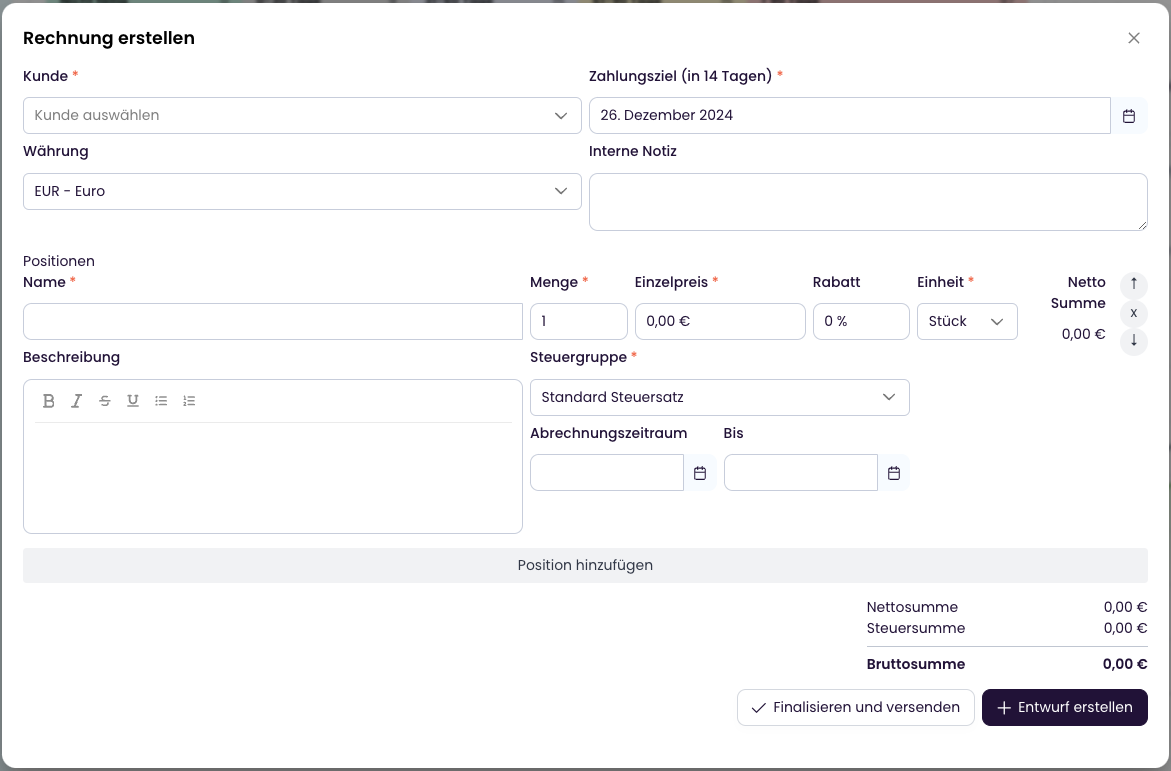
You can manually create a new invoice at any time:- Click on the
+in the top right - Select “Invoice”
- Select the customer
- Add invoice items
- Click on
Create DraftorFinalize and Send
Automatic Invoice Creation
Invoices for subscriptions are automatically created at the configured time. Invoicing occurs:- At the start of a new billing period
- When subscription changes occur (prorated billing)
- For additional charges or credits
Finalize and Send
After you have created an invoice, you can finalize it and send it to the customer. The following happens:- The invoice is generated as a PDF and/or e-invoice XML
- The customer receives an email with the invoice as an attachment, provided notification settings are enabled
- Corresponding journal entries are automatically created
- The invoice is marked with status
Open - Payment collection is initiated
- The invoice is sent to BCC recipients if needed
Notifications
Resend Invoice by Email
You can resend an invoice to your customer by email at any time:- Using the Web App
- Using the API
1
Open Invoice
Navigate to the desired invoice in the invoice overview
2
Select Action
Click on
Actions > ResendActivity Log
Every change to an invoice is documented in the activity log. You can find the log directly in the detail view of an invoice in the “History” section. There you can see:- Who made the change
- What was changed
- When the change occurred
Payments
Payments can be manually added or retried for invoices. For more details, see Manage Payments.Payment Reminders / Dunning
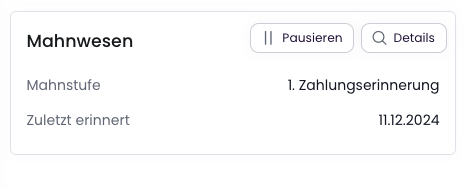
- The current dunning level
- The date of the last reminder
- Option to pause dunning
- Access to dunning process details
You can pause dunning for individual invoices. This is useful when, for example:
- You have agreed on an installment payment plan with the customer
- A payment deadline has been extended
- You are waiting for a pending credit note
- An invoice is 10 days overdue and at dunning level 1
- You pause dunning for 14 days due to an installment payment agreement
- After reactivation (day 24), dunning level 2 automatically applies, as the deadline for dunning level 1 (e.g., 7 days) has already been exceeded
Cancel Invoices
An invoice can only be canceled if:
- No payment has been received yet
- For in-house SEPA: The SEPA file has not yet been marked as “uploaded”
- Using the Web App
- Using the API
1
Open Invoice
Navigate to the desired invoice in the invoice overview
2
Execute Cancellation
Click on
Cancel3
Confirm Cancellation
Choose one of the following options:
Yes, cancel: The invoice will simply be canceledYes, cancel and duplicate: The invoice will be canceled and a new invoice with the same items will be created
- A cancellation invoice is created that offsets the original invoice
- If journal entries are enabled, corresponding cancellation entries (e.g., deferred revenue) are automatically executed
- The customer receives a notification by email if this is enabled in the notification settings
Close Invoice
To remove invoices from the overview, you can close them. This is useful when you want to archive invoices that are no longer relevant and have not yet been sent to the customer. Requirements for closing an invoice:- The invoice is in status
DraftorPending Approval
- The invoice is hidden in the overview
- The invoice can no longer be edited
- The invoice amounts are not included in statistics and reports
- The invoice is logged as “closed” in the activity log
- Using the Web App
- Using the API
1
Open Invoice
Navigate to the desired invoice in the invoice overview
2
Close Invoice
Click on
Actions > Close Invoice3
Confirm Closing
Confirm closing the invoice with 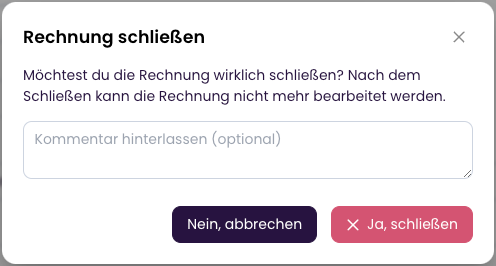
Yes, close. Optionally, you can add a note that will be logged in the history.Create Credit Note
Credit notes can be created for invoices to reduce the invoice amount. This is useful when, for example:- A discount is granted retroactively
- The invoice amount needs to be corrected
- A product has been returned
- Using the Web App
- Using the API
1
Open Invoice
Navigate to the desired invoice in the invoice overview
2
Create Credit Note
Click on
Actions > Create Credit Note3
Confirm Credit Note
Select the items and quantities to be credited. You can also add custom text for the credit note,
which will be displayed on the credit note below the items and above the general “closing” text.The “closing” text can be customized under “Settings” > “Documents” > “Templates” > “Credit Notes”.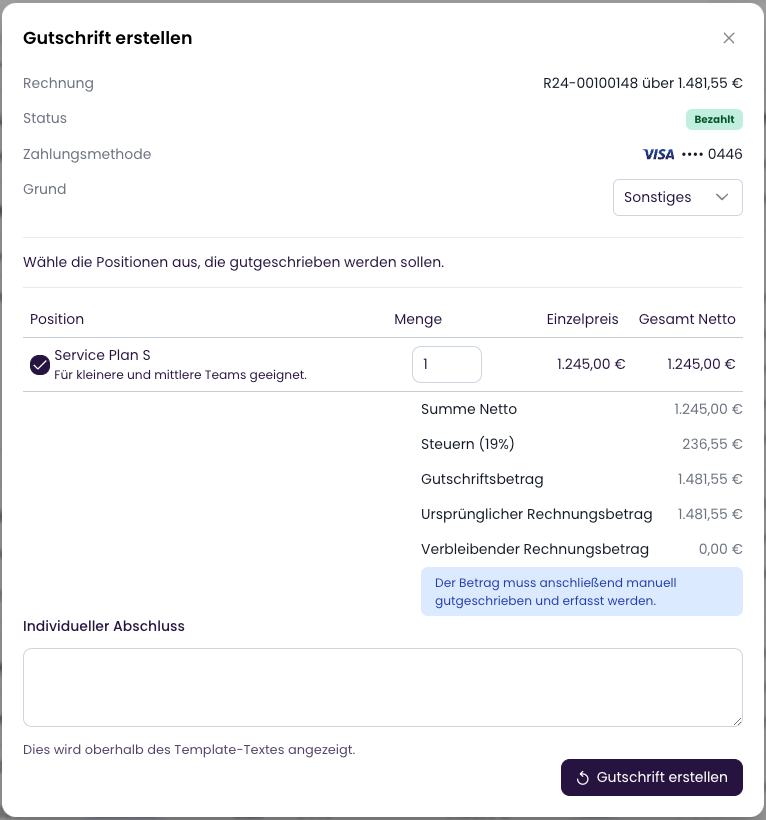
4
Credit Note Created
The credit note has been created and the invoice amounts have been automatically adjusted. The credit note is marked with status
Open.Subsequently:- the customer is informed about the credit note (if enabled in the notification settings)
- the credit note is documented in the activity log
- the journal entries are automatically created
The quantity of credited items is deducted from the invoice. The quantity cannot be credited again.
5
Record Amount
To mark the credit note as
Paid, you can add a payment corresponding to the credited amount. The amount must be positive.See Manage Payments for this.